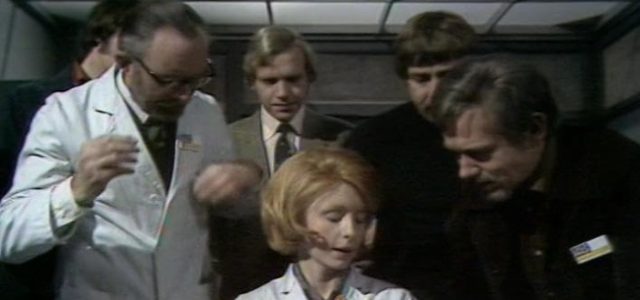
Directed by Peter Sasdy and written by the legendary science-fiction visionary Nigel Kneale (creator of the Quatermass series), The Stone Tape is a landmark of British television horror. Originally produced as a BBC Christmas ghost story, it has since earned a reputation as one of the most intelligent and terrifying blends of supernatural haunting and hard science fiction ever filmed.
The Plot Synopsis
A high-tech research team from an electronics corporation, led by the ambitious Peter Brock (Michael Bryant), moves into a renovator’s dream: Taskerlands, a Victorian mansion built atop much older foundations. Their goal is to develop a revolutionary new recording medium to outpace their Japanese competitors.
The team’s plans are derailed when the group’s gifted computer programmer, Jill Greeley (Jane Asher), experiences a harrowing supernatural encounter in a room the builders refuse to finish. She sees and hears the ghost of a woman dying in terror—a scream that seems to echo through time.
While the skeptical Brock initially dismisses it as hysteria, he soon realizes that the “ghost” is remarkably consistent. He theorizes that the ancient stone walls of the room have acted like a giant recording surface, “storing” the traumatic event for centuries. The team turns their sophisticated acoustic equipment toward the walls, hoping to “play back” the haunting and unlock the secrets of the stone. However, their scientific probing begins to peel back layers of much older, more malevolent memories that were never meant to be disturbed.
Key Cast and Crew
| Role | Name |
| Director | Peter Sasdy |
| Writer | Nigel Kneale |
| Jill Greeley | Jane Asher |
| Peter Brock | Michael Bryant |
| Roy | Iain Cuthbertson |
| The Ghost (Louisa) | Hedley Goodall |
Atmosphere and Influence
-
The “Stone Tape Theory”: This film popularized the real-world paranormal hypothesis that minerals and buildings can absorb emotional energy. If you’ve ever heard a ghost hunter talk about “residual hauntings,” they are referencing the concept Kneale pioneered here.
-
Sound Design: The film is famous for its unsettling, avant-garde electronic score and sound effects provided by the BBC Radiophonic Workshop (the same team behind the Doctor Who theme).
-
Psychological Dread: Rather than relying on jump scares or makeup, the film builds a crushing sense of inevitability as science fails to contain a phenomenon it doesn’t truly understand.
Historical Note: While often associated with 1974 due to international broadcasts, it actually premiered on the BBC on Christmas Day, 1972. It remains a masterclass in how to be deeply frightening on a television budget.
Nigel Kneale had a knack for making “magic” feel like “undiscovered physics,” didn’t he? Does the idea of a scientific explanation for ghosts make them more or less scary to you?