
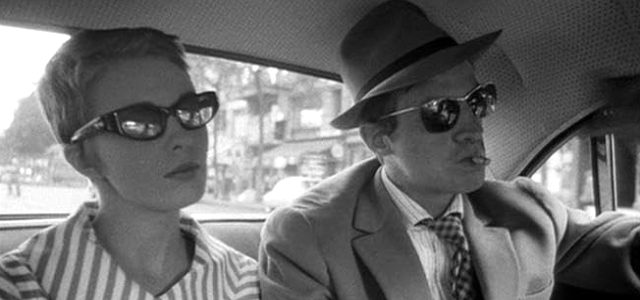
Original title: À bout de souffle
Directed by Jean-Luc Godard, Breathless is the explosive debut that redefined cinema forever. A cornerstone of the French New Wave, it shattered traditional storytelling rules with its restless energy, iconic jump cuts, and cool, existential attitude.
The Synopsis
The story follows Michel Poiccard, a young, nihilistic car thief who styles himself after the tough-guy persona of Humphrey Bogart. After stealing a car in Marseille, Michel impulsively shoots a motorcycle cop who pursues him on a country road. Now a fugitive on the run, he flees to Paris to hide out and collect a debt.
While navigating the streets of the capital, he reconnects with Patricia Franchini, an American journalism student who sells the New York Herald Tribune on the Champs-Élysées. Michel is infatuated with her and attempts to persuade her to run away with him to Italy. Patricia, however, is conflicted; she is charmed by Michel’s reckless spontaneity but is also focused on her own burgeoning career and intellectual independence. As the police close in and Michel’s face plastered on the front page of every newspaper, the film becomes a tense, philosophical cat-and-mouse game. It explores the tension between a man who lives entirely for the moment and a woman who is just beginning to wonder what her future holds.
Cast & Crew
| Role | Name |
| Director | Jean-Luc Godard |
| Screenplay | Jean-Luc Godard (based on an idea by François Truffaut) |
| Michel Poiccard | Jean-Paul Belmondo |
| Patricia Franchini | Jean Seberg |
| Inspector Vital | Daniel Boulanger |
Production Notes
-
The Jump Cut: Godard famously used “jump cuts” (abrupt transitions within a single scene) to speed up the film’s pacing. While originally a solution to make the movie shorter, it became a revolutionary stylistic choice that gave the film its “breathless,” fragmented feel.
-
Improvisational Style: The film was shot without a traditional script. Godard would write dialogue in a notebook each morning before filming, often whispering lines to the actors during the takes to keep their reactions fresh and natural.
-
On-Location Grit: Eschewing expensive sets, Godard and his cinematographer, Raoul Coutard, filmed on the streets of Paris using a handheld camera and natural light. This gave the movie a raw, documentary-like quality that felt radically modern in 1960.
-
Cultural Iconography: Jean-Paul Belmondo’s thumb-across-the-lip gesture and Jean Seberg’s pixie haircut and “New York Herald Tribune” t-shirt became instant symbols of 1960s cool, influencing fashion and attitude for decades to come.