
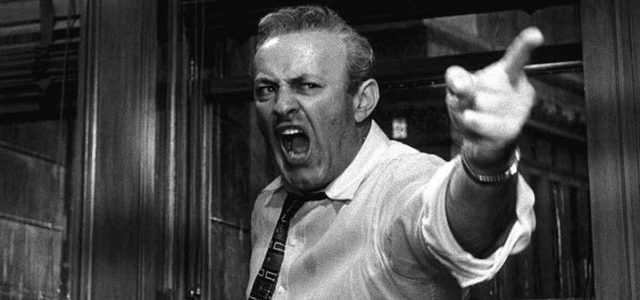
Directed by Sidney Lumet in his directorial debut, 12 Angry Men is a cinematic masterclass in tension, dialogue, and the power of the “chamber piece.” Adapted from Reginald Rose’s teleplay, the film is celebrated for its ability to create a high-stakes thriller within the confines of a single, sweltering room.
The Plot Synopsis
Following the closing arguments in a New York City murder trial, a 12-man jury is sent to a small, claustrophobic deliberation room to decide the fate of a teenage boy accused of fatally stabbing his father. The case appears to be an open-and-shut matter: the evidence is overwhelming, the witnesses are certain, and the defendant faces a mandatory death sentence.
A preliminary vote reveals that 11 of the jurors are ready to convict. However, Juror 8 (Henry Fonda) casts the lone “not guilty” vote. He admits he doesn’t necessarily believe the boy is innocent, but he feels the gravity of a death sentence requires at least a discussion of “reasonable doubt.”
What follows is an intense, psychological battle of wills. As the temperature in the room rises and the jurors’ personal prejudices, backgrounds, and tempers are pushed to the surface, Juror 8 methodically begins to dismantle the “ironclad” evidence. One by one, the men are forced to confront their own biases and re-examine the facts, leading to a volatile transformation of the group dynamic.
Key Cast and Crew
| Juror | Actor | Defining Characteristic |
| Director | Sidney Lumet | — |
| Juror 8 | Henry Fonda | The thoughtful architect of doubt. |
| Juror 3 | Lee J. Cobb | The vengeful, angry antagonist. |
| Juror 10 | Ed Begley | The loud, prejudiced bigot. |
| Juror 7 | Jack Warden | The salesman eager to get to a ballgame. |
| Juror 9 | Joseph Sweeney | The observant, elderly man. |
| Juror 4 | E.G. Marshall | The analytical, rational stockbroker. |
Cinematic Technique
-
The “Lensing” Trick: To increase the sense of claustrophobia, Lumet gradually swapped to lenses with longer focal lengths as the movie progressed. This made the walls appear to close in on the actors, heightening the psychological pressure on the audience.
-
The Script: The film relies entirely on character development and logic rather than action, making it a staple of law schools and leadership seminars worldwide.
-
Themes: It serves as a profound exploration of the American judicial system, the danger of apathy, and the courage it takes to stand alone against a majority.
Fun Fact: Despite its status today as one of the greatest films ever made, it was a box-office disappointment upon its initial release. It only achieved legendary status after becoming a staple on television.