
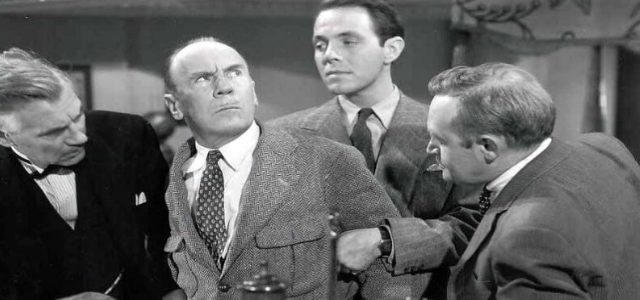
And Then There Were None is a masterful 1945 adaptation of Agatha Christie’s best-selling mystery novel. Directed by René Clair, this version is celebrated for its elegant “whodunit” structure, blending dark suspense with a surprisingly playful sense of macabre humour.
The Synopsis
Ten strangers, each with a hidden secret, are invited to a lavish, isolated estate on Indian Island off the coast of Devon by a mysterious host named U.N. Owen. Upon arrival, the guests discover that their host is absent, leaving only a cryptic gramophone recording that accuses every person present—including the two house servants—of having committed a murder in their past that the law could not touch.
The tension turns to terror when one of the guests suddenly drops dead. The survivors soon notice a centerpiece on the dining table: ten porcelain figurines that correspond to the nursery rhyme “Ten Little Indians.” As the guests are picked off one by one in ways that mirror the lines of the poem, the figurines are broken or disappear.
With no way to leave the island and no one else present, the group realizes with mounting horror that the killer is one of them. Paranoia takes hold as the remaining guests attempt to outsmart a brilliant mastermind who seems to know their every weakness.
Cast and Crew
| Role | Name |
| Director | René Clair |
| Judge Francis J. Quincannon | Barry Fitzgerald |
| Philip Lombard | Louis Hayward |
| Vera Claythorne | June Duprez |
| Dr. Edward G. Armstrong | Walter Huston |
| William Henry Blore | Roland Young |
| General Sir John Mandrake | C. Aubrey Smith |
Legacy & Trivia
-
The “Clair” Touch: Director René Clair brought a distinct European flair to the film, using clever camera angles and subtle wit to balance the grim subject matter.
-
The Ending: Fans of the original novel often note that this 1945 version follows the stage play ending rather than the much darker conclusion of the book, making it slightly more palatable for audiences of the era.
-
Master Class in Acting: The film features an “ensemble cast” in the truest sense, populated by some of the most famous character actors of the 1940s, making every character feel like a potential lead—and a potential suspect.
-
Public Domain: Due to a failure to renew its copyright, the film was in the public domain for many years, leading to many low-quality versions before recent high-definition restorations preserved its atmospheric cinematography.
“Ten little Indians, sitting in a line… one fell down and then there were nine.”