
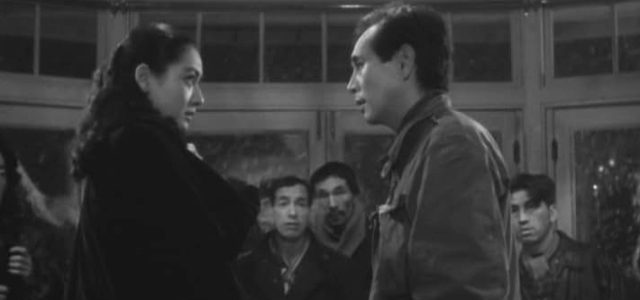
Directed by Akira Kurosawa, The Idiot (Hakuchi) is a bold, atmospheric adaptation of Fyodor Dostoevsky’s classic novel. Relocating the story from 19th-century Russia to the stark, snow-covered landscapes of post-WWII Hokkaido, Kurosawa transforms the Russian masterpiece into a haunting Japanese melodrama about the fragility of goodness in a cynical world.
The Premise
The story follows Kameda (Masayuki Mori), a man who was sentenced to death as a war criminal only to be granted a last-minute reprieve. The trauma of the experience has left him with a childlike innocence and a form of “idiocy”—a state of pure, unfiltered empathy and hyper-sensitivity to the suffering of others.
Returning to his home in Hokkaido, Kameda meets the brooding, volatile Akama (Toshiro Mifune) on a train. Through Akama, Kameda is introduced to the beautiful but tragic Taeko Nasu (Setsuko Hara), a woman who has been socially shunned and emotionally scarred by years of being “kept” by a wealthy businessman.
The Conflict
Kameda’s return sparks a complex and destructive web of relationships:
-
The Love Triangle: Both Akama and Kameda are transfixed by Taeko—Akama by a possessive, violent lust, and Kameda by a deep, spiritual compassion.
-
The Social Pariah: Taeko is treated as a piece of property to be traded, with a large dowry offered to anyone willing to marry her to save her former lover’s reputation.
-
The Innocent: As Kameda navigates this “faithless world,” he finds himself torn between his bond with Taeko and a developing relationship with Ayako (Yoshiko Kuga), the daughter of his relative.
Kameda’s refusal to judge anyone leads the characters toward a tragic collision, as his “idiotic” honesty forces everyone around him to confront their own greed, jealousy, and inner darkness.
Key Cast and Crew
-
Director: Akira Kurosawa
-
Kinji Kameda: Masayuki Mori
-
Denkichi Akama: Toshiro Mifune
-
Taeko Nasu: Setsuko Hara
-
Ayako: Yoshiko Kuga
-
Mr. Ono: Takashi Shimura
Notable Elements
-
A Lost Vision: Kurosawa originally turned in a 265-minute cut of the film, which he considered one of his finest works. The studio, horrified by the length, cut it down significantly. The missing footage has never been recovered, making the surviving version a fascinating “fragment” of Kurosawa’s grander vision.
-
The Setting: By choosing the freezing, Russian-influenced island of Hokkaido, Kurosawa perfectly captures the Dostoevskian “winter of the soul.” The film features the first cinematic footage of the now-famous Sapporo Snow Festival.
-
Performances: The film features an incredible “triple threat” of legendary Japanese actors: Mori’s ethereal stillness, Mifune’s animalistic intensity, and Hara’s uncharacteristic, high-tension melodrama.
“Goodness and idiocy are often equated in this world.” — The Prologue