
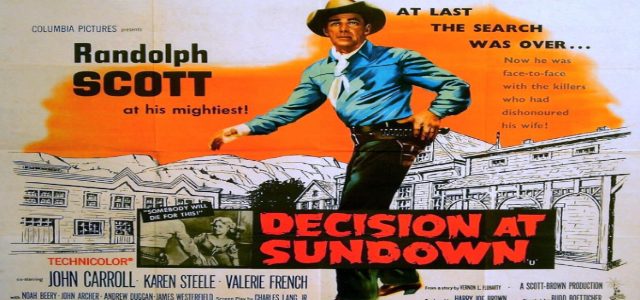
Directed by the master of the “psychological Western,” Budd Boetticher, this film is a standout entry in the famous “Ranown” cycle—a series of lean, gritty Westerns made in collaboration with star Randolph Scott. Unlike the sweeping epics of the era, this is a claustrophobic, character-driven study of vengeance and disillusionment.
The Plot
Bart Allison arrives in the town of Sundown with a single, obsessive purpose: to kill Tate Kimbrough. Accompanied by his loyal friend Sam, Allison interrupts Kimbrough’s wedding day, claiming that the groom was responsible for the death of Allison’s wife years prior.
However, Allison soon discovers that Sundown is not a typical frontier town. Kimbrough effectively owns the community, keeping the citizens under his thumb through a mix of corruption and his hired gun, the lethal Dawson. As Allison and Sam barricade themselves in a livery stable, a tense standoff ensues.
The film subverts traditional Western tropes by questioning the hero’s motives. As the hours pass toward sundown, the townspeople are forced to confront their own cowardice, while Allison is forced to confront a painful truth: his memory of his “saintly” late wife—and the righteousness of his quest for revenge—might be a total delusion.
Cast & Crew
| Role | Contributor |
| Director | Budd Boetticher |
| Bart Allison | Randolph Scott |
| Tate Kimbrough | John Carroll |
| Ruby James | Karen Steele |
| Sam | Noah Beery Jr. |
| Dawson | Andrew Duggan |
Key Highlights
-
The “Ranown” Edge: This collaboration between Boetticher, Scott, and producer Harry Joe Brown is celebrated for its stripped-down storytelling and moral ambiguity.
-
Psychological Depth: Rather than focusing on grand shootouts, the film builds tension through dialogue and the shifting loyalties of the townspeople.
-
Randolph Scott’s Performance: Known for playing stoic heroes, Scott delivers a much darker, more frayed performance here as a man consumed by a potentially misplaced hatred.
Note: Fans of the genre often point to Decision at Sundown as one of the most cynical Westerns of the 1950s, as it refuses to give the audience—or the protagonist—a traditional “clean” victory.