
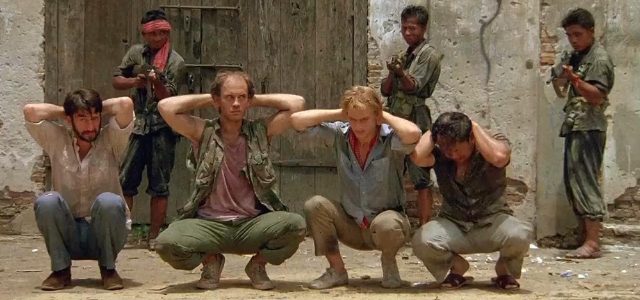
Directed by Roland Joffé, The Killing Fields (1984) is a harrowing and deeply moving biographical drama based on the true story of two journalists caught in the Khmer Rouge’s bloody takeover of Cambodia. It is a profound exploration of professional ethics, survival, and a friendship that transcends borders and ideologies.
The Premise
The story follows Sydney Schanberg, a driven and ambitious foreign correspondent for The New York Times, and his local colleague and friend, Dith Pran, who acts as his fixer, translator, and essential eyes on the ground. As the Cambodian Civil War reaches its breaking point in 1975, the American military begins to evacuate the capital, Phnom Penh.
While the Westerners are urged to leave, Schanberg decides to stay to cover the fall of the city to the Khmer Rouge, and Pran chooses to remain by his side to ensure the story is told. However, when the “Year Zero” revolution begins, the city is transformed into a nightmare of radical ideology.
The Conflict
The narrative splits into two parallel, emotionally charged journeys:
-
The Guilt of the Survivor: Back in the United States, Schanberg receives prestigious awards for his reporting but is haunted by the fact that he was unable to secure Pran’s safety. He begins an obsessive search for news of his friend, plagued by the fear that his own professional ambition may have cost Pran his life.
-
The Struggle for Survival: Left behind in Cambodia, Pran is sent to a forced-labor “re-education” camp. He must navigate the horrific reality of the “Killing Fields”—mass graves of those deemed enemies of the state—while concealing his education and past as a journalist to avoid execution.
The film follows Pran’s desperate attempt to escape across the countryside and Schanberg’s tireless efforts to find him, culminating in a search for redemption amidst one of the 20th century’s greatest tragedies.
Key Cast and Crew
| Role | Personnel |
| Director | Roland Joffé |
| Sydney Schanberg | Sam Waterston |
| Dith Pran | Haing S. Ngor |
| Al Rockoff (Photographer) | John Malkovich |
| Jon Swain | Julian Sands |
| Morgan | Craig T. Nelson |
Why It’s a Vital Film
-
Haing S. Ngor’s Performance: In one of the most remarkable debuts in history, Ngor—a non-professional actor and a real-life survivor of the Khmer Rouge—won the Academy Award for Best Supporting Actor. His performance is imbued with a raw, authentic pain that is impossible to replicate.
-
Visceral Realism: The film is noted for its uncompromising depiction of the Cambodian genocide, using stark imagery and an eerie, synth-heavy score by Mike Oldfield to create a sense of lingering dread.
-
A Tribute to Journalism: It remains one of the most powerful depictions of the risks foreign correspondents take and the often-overlooked “local heroes” who make their reporting possible.