
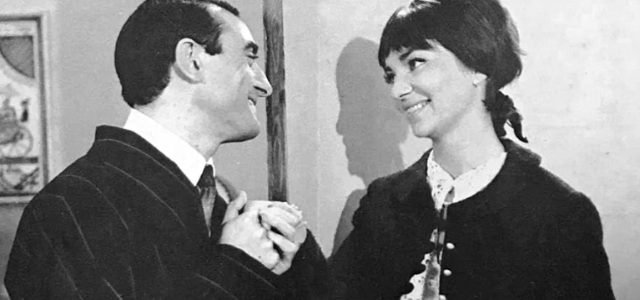
Original title: Tant qu’on a la santé
Directed by Pierre Étaix, As Long as You’ve Got Your Health is an inventive portmanteau film consisting of four distinct but thematically linked stories. It is widely considered one of Étaix’s most accomplished works, showcasing his transition from pure slapstick into a more surreal, satirical observation of the stresses of modern life.
The Synopsis
The film is structured as four interconnected vignettes, each exploring a different facet of how the “progress” of the 20th century chips away at the human spirit:
-
Insomnia: A man attempts to read a book about vampires before bed, only to find his reality blurring with the Gothic horror of the story in a series of eerie, dreamlike sight gags.
-
The Movies: A hilarious look at the frustrations of the cinema-going experience, from the struggle to find a seat to the absurdity of the advertisements and trailers that precede the main event.
-
Keep Your Health: In the film’s namesake segment, a man deals with the frantic pace of city life, modern medicine, and the physical toll of a world that never stops moving.
-
The Picnic: A middle-class couple tries to enjoy a peaceful day in the countryside, but finds their pastoral dream interrupted by fences, tractors, and the encroaching machinery of the industrial world.
Across all four stories, Étaix plays a variation of his “every-man” character—a quiet, dignified soul caught in the gears of a society that is becoming increasingly loud, crowded, and mechanical.
Cast & Crew
| Role | Name |
| Director | Pierre Étaix |
| Screenwriter | Jean-Claude Carrière & Pierre Étaix |
| The Protagonist | Pierre Étaix |
| The Wife | Denise Péronne |
| Various Roles | Claude Mansard |
| Various Roles | Véra Valmont |
Production Notes
-
Evolution of the Film: The version most commonly seen today was re-edited by Étaix himself years after its release. He replaced one of the original segments (“Feeling Good“) with the “Insomnia” sequence, which he felt better suited the film’s overall rhythm.
-
Visual Poetry: The “Insomnia” sequence is often cited by critics as one of the most beautiful and creative moments in French comedy, utilising trick photography and precise lighting to blend two different worlds into one frame.
-
Social Critique: While the film is incredibly funny, it carries a sharper edge than Étaix’s earlier work. It serves as a precursor to the themes of noise and urban chaos that his mentor, Jacques Tati, would later explore in Playtime.
-
Tati vs. Étaix: While Tati often focused on the architecture and the “big picture” of modern life, Étaix keeps the focus on the individual’s internal experience, using his background as a clown to show the physical strain of simply trying to “stay healthy” in a frantic world.