
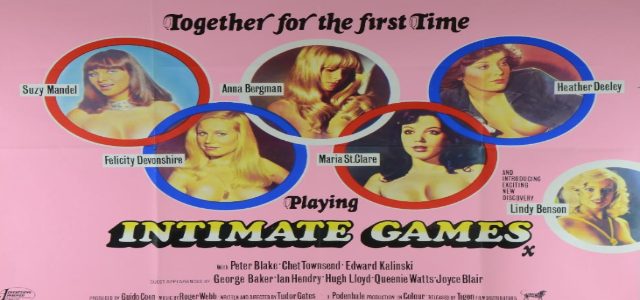
Directed by Tudor Gates (better known as a prolific screenwriter for films like Barbarella and Danger: Diabolik), Intimate Games is a British sex comedy that leans into the “portmanteau” or anthology style popular in the 1970s. It frames its adult themes within a psychological and academic context, exploring the boundary between subconscious fantasy and reality.
The Synopsis
The film is set at a contemporary university where a group of students is participating in a field study led by a sociology professor. The project requires the students to record and share their most private, vivid fantasies as part of a deep-dive into the human psyche.
As the students recount their inner thoughts, the film transitions into a series of stylised vignettes that bring these fantasies to life. These sequences range from the whimsical and humorous to the surreal and provocative, covering a wide spectrum of romantic and erotic imaginings. However, the narrative takes a turn as the “games” begin to spill over into the students’ actual lives. The experiment begins to heighten the tensions, jealousies, and attractions within the group, forcing the participants to confront whether voicing a fantasy makes it more likely to happen—or more dangerous to pursue.
Cast & Crew
| Role | Name |
| Director | Tudor Gates |
| Professor Gottlieb | George Baker |
| Suzy | Anna Bergman |
| John | Peter Blake |
| Marian | Heather Deeley |
| Executive | John Benson |
Production Notes
-
The Tudor Gates Touch: While Gates was a veteran of high-concept thrillers and cult classics, this film represents his foray into the “saucy” British sub-genre that dominated the mid-70s. He brings a slightly more structured, narrative approach to the material than was typical for the era.
-
Psychological Framing: Unlike many of its contemporaries that relied solely on slapstick, Intimate Games attempts to use the “student experiment” trope to provide a veneer of social commentary on the changing sexual mores of the 1970s.
-
Atmosphere: The film captures the specific aesthetic of mid-70s Britain, blending academic settings with the psychedelic, dream-like visuals used to depict the characters’ internal fantasy worlds.