
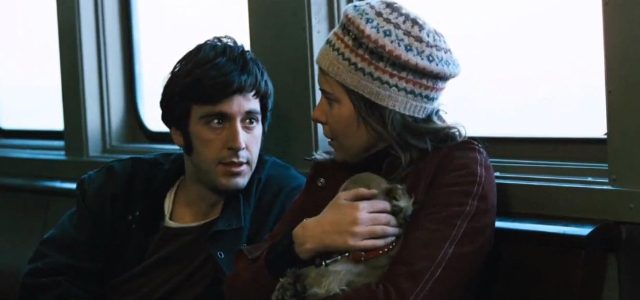
Directed by Jerry Schatzberg, The Panic in Needle Park is a gritty, uncompromising look at the lives of heroin addicts in New York City. It is a landmark of “New Hollywood” cinema, eschewing melodrama in favor of a raw, documentary-style realism that shocked audiences upon its release.
The Plot Synopsis
The story centers on a young, adrift woman named Helen (Kitty Winn) who has recently moved to the city. Vulnerable and searching for connection, she falls in love with Bobby (Al Pacino), a charismatic, fast-talking small-time hustler. Bobby is a regular in “Needle Park,” the nickname for Sherman Square on Manhattan’s Upper West Side, where addicts and dealers congregate.
As their relationship deepens, Helen is gradually drawn into Bobby’s world. What begins as a romantic bond soon descends into a shared cycle of dependency. Their lives are dictated by the “panic”—a term used by the street community to describe a heroin shortage that sends the local addicts into a desperate, frantic scramble to secure their next fix at any cost.
The film follows the couple as they navigate a landscape of cheap hotels, betrayal, and the eroding of their own moral boundaries. It is less a story about the drug itself and more a devastating character study of how addiction can dismantle the soul, testing the limits of love and loyalty in a world that offers no safety net.
Key Cast and Crew
| Role | Name |
| Director | Jerry Schatzberg |
| Bobby | Al Pacino |
| Helen | Kitty Winn |
| Hotch | Richard Bright |
| Hank | Alan Vint |
| Detective Hotchner | Kiel Martin |
| Screenwriters | Joan Didion & John Gregory Dunne |
Historical Significance
-
The Debut of a Legend: This was Al Pacino’s first starring role. His performance was so electric that it caught the attention of Francis Ford Coppola, who subsequently cast him as Michael Corleone in The Godfather.
-
Cannes Success: Kitty Winn won the Best Actress award at the Cannes Film Festival for her haunting portrayal of Helen’s physical and emotional decline.
-
The “Didion” Touch: The screenplay was co-written by the celebrated essayist Joan Didion, whose clinical, detached observation of social decay is felt in every scene.
-
No Musical Score: In a bold creative choice, the film has no musical soundtrack, relying entirely on the abrasive, ambient sounds of 1970s New York to heighten its sense of bleak reality.
The Vibe: This is a “street-level” movie in every sense. It doesn’t judge its characters, but it doesn’t look away, either.