
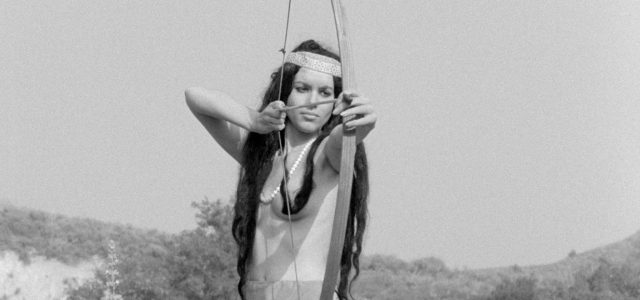
Directed by Peter Perry Jr. and featuring a screenplay by the legendary “Worst Director of All Time,” Edward D. Wood Jr. (who reportedly wrote it under a pseudonym to settle a debt), Revenge of the Virgins is a quintessential “Z-movie” from the golden age of exploitation cinema. It is a bizarre, ultra-low-budget blend of a Western and a “jungle girl” adventure.
The Plot Synopsis
The story follows a ragtag group of five gold-seekers in the Old West. Led by a greedy, ruthless protagonist and a corrupt lawman, the group ventures deep into the uncharted territory of the “Forbidden Canyon” in search of a legendary gold mine hidden within a sacred Indian burial ground.
Their quest for wealth is cut short when they encounter a tribe of fierce, spear-wielding women. These women are the “Virgins” of the title—white-skinned protectors of the gold who are dressed in scant, fur-lined outfits and are sworn to execute any man who dares to desecrate their land.
As the prospectors’ greed turns them against one another, they find themselves systematically hunted by the tribe. The film devolves into a desperate struggle for survival as the men realize that the gold they’ve found may be the very thing that leads to their doom. Between the clunky dialogue and the surreal encounters in the woods, the film explores the classic “Wood-ian” themes of human greed versus a mysterious, female-led society.
Key Cast and Crew
| Role | Name |
| Director | Peter Perry Jr. |
| Writer | Edward D. Wood Jr. (as Pete La Roche) |
| Pan Tawn | Jan McLendon |
| Mel | Charles (Charlie) McCarty |
| The Sheriff | Kenne Duncan |
| Goldie | Joanne (Joi) Lansing |
| Teepee | Delores Reed |
Why It’s a Cult Curiosity
-
The Ed Wood Connection: While Wood didn’t direct, his fingerprints are all over the eccentric, purple prose and the illogical plot progression. It has the same “unintentional comedy” charm found in Plan 9 from Outer Space.
-
Anachronisms Galore: Despite being set in the era of the Old West, many of the characters sport very 1950s hairstyles and makeup, and the “jungle” tribe appears to live in a forest that looks suspiciously like a Los Angeles city park.
-
The Nudie-Cutie Era: This film is a prime example of the “nudie-cutie” genre that was popular in the late 50s—movies that pushed the boundaries of the Hays Code with provocative costumes and themes without being explicitly pornographic.
The Vibe: It’s a drive-in theater relic that is best enjoyed with a high tolerance for camp and a love for the “so-bad-it’s-good” corner of film history.