
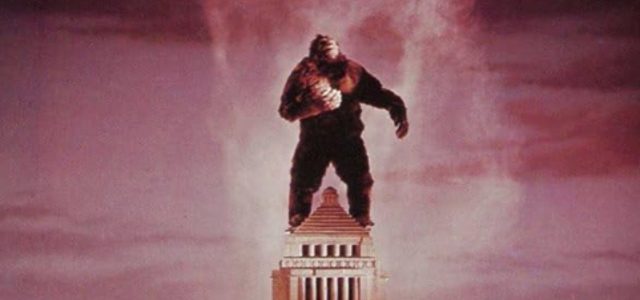
Directed by the legendary Ishirō Honda, with groundbreaking special effects by Eiji Tsuburaya, King Kong vs. Godzilla (1962) is the historic third entry in both franchises. It was the first time either monster appeared in color and widescreen, pitting the “Eighth Wonder of the World” against the “King of the Monsters” in a clash of global icons.
The Premise
The story follows two parallel events that inevitably collide. In the Arctic, an American nuclear submarine accidentally strikes a massive iceberg, which shatters to reveal a hibernating Godzilla. Free from his icy prison for the first time in seven years, the monster begins a destructive southward trek toward Japan.
Meanwhile, the eccentric head of Pacific Pharmaceuticals, Mr. Tako, is desperate to boost the ratings of his company’s sponsored television program. Hearing rumors of a “Giant Demon God” on the remote Faro Island, he dispatches two reluctant employees to capture the beast and bring it back to Tokyo as the ultimate publicity stunt. That “god” is, of course, King Kong.
The Conflict
Chaos ensues when King Kong escapes his captors upon reaching Japan. Driven by territorial instinct, the two titans find themselves on a collision course across the Japanese countryside. The film explores:
-
The Corporate Satire: A lighthearted look at 1960s consumerism and media frenzy, as Mr. Tako prioritizes ratings over public safety.
-
The Military Response: The JSDF attempts to halt the monsters with everything from high-voltage power lines to massive pits, eventually realizing that the only way to stop one monster may be to let the other fight it.
-
The Climax: The rivalry culminates in a spectacular wrestling-style brawl on the slopes of Mount Fuji, where Kong’s surprising affinity for electricity gives him a fighting chance against Godzilla’s devastating atomic breath.
Key Cast and Crew
| Role | Personnel |
| Director | Ishirō Honda |
| Special Effects Director | Eiji Tsuburaya |
| Osamu Sakurai | Tadao Takashima |
| Kazuo Fujita | Kenji Sahara |
| Mr. Tako | Ichirō Arishima |
| Fumiko Sakurai | Mie Hama |
| Kinsaburo Furue | Yū Fujiki |
| Godzilla (Suit Actor) | Haruo Nakajima |
| King Kong (Suit Actor) | Shoichi Hirose |
Why It’s a Milestone
-
A Change in Tone: After the grim, nuclear-horror tone of the 1954 original, this film moved the series toward a lighter, more action-oriented style designed to appeal to families.
-
The “Dual Ending” Myth: For years, a popular urban legend claimed that Godzilla won in the Japanese version and Kong won in the American version. In reality, the outcome is the same in both versions, though the English edit features significant changes to the score and human scenes.
-
Professional Wrestling Influence: The monster choreography was heavily inspired by the surging popularity of pro wrestling in Japan, featuring boulders being tossed, tail-swings, and physical comedy.