
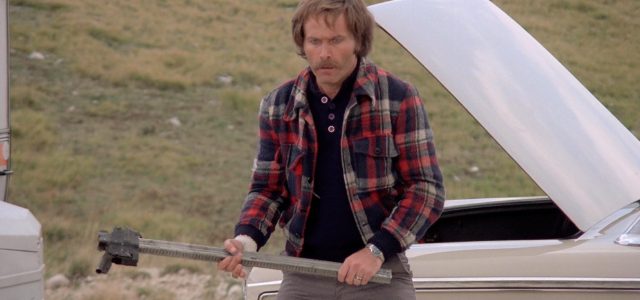
Directed by Pasquale Festa Campanile, Hitch-Hike (1977)—originally titled Autostop rosso sangue—is a brutal and unrelenting Italian road thriller. While it shares DNA with “exploitation” cinema of the 70s, it is elevated by a high-profile cast and a haunting musical score by the legendary Ennio Morricone.
The Premise
The story follows Walter Mancini, a cynical, heavy-drinking journalist, and his wife Eve, as they embark on a road trip across the American West in a car hauling a camping trailer. Their marriage is in a state of toxic decay, characterized by mutual resentment and bitter verbal sparring.
In an attempt to break the suffocating tension between them, they pull over to pick up a hitchhiker named Adam Konitz, whose car has supposedly broken down. It is a decision they immediately regret, as the stranger is far from a stranded traveler.
The Conflict
The narrative transforms into a claustrophobic nightmare on wheels once Konitz’s true identity is revealed:
-
The Hostage Situation: Konitz is a sadistic fugitive and escaped mental patient who has just robbed two million dollars. He takes the couple hostage, forcing them to drive him toward the Mexican border.
-
Psychological Warfare: Rather than relying solely on physical threats, Konitz delights in manipulating the already fractured relationship between Walter and Eve. He exploits their marital cracks for his own amusement, pitting husband against wife in a series of cruel psychological games.
-
The Descent: As the trio travels through the desolate landscape, the “civilized” veneer of the Mancinis begins to strip away. Faced with Konitz’s joyful nihilism, Walter and Eve are forced to confront the darkest parts of their own natures just to survive.
The film is a stark examination of moral deterioration, where the line between the “heroic” victims and the “villainous” captor becomes increasingly blurred by greed and desperation.
Key Cast and Crew
| Role | Personnel |
| Director | Pasquale Festa Campanile |
| Composer | Ennio Morricone |
| Walter Mancini | Franco Nero |
| Eve Mancini | Corinne Cléry |
| Adam Konitz | David Hess |
| Oaks | Joshua Sinclair |
| Hawk | Carlo Puri |
Why It’s a Cult Classic
-
David Hess: Following his terrifying performance in The Last House on the Left, Hess solidified his reputation as one of cinema’s most effective portrayers of pure, unhinged malice.
-
Franco Nero’s Departure: Usually seen as a stoic, heroic lead in Spaghetti Westerns (like Django), Nero delivers a raw and unglamorous performance as a deeply flawed man struggling with alcoholism and cowardice.
-
Sun-Drenched Terror: Much like The Texas Chain Saw Massacre, the film uses the bright, oppressive heat of the open road to create a sense of inescapable dread, proving that horror doesn’t need shadows to be effective.