
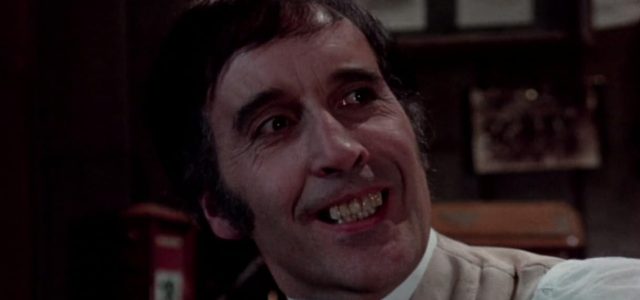
Directed by Stephen Weeks, I, Monster is a stylish and psychologically focused reimagining of Robert Louis Stevenson’s classic novella, The Strange Case of Dr. Jekyll and Mr. Hyde. Produced by Amicus Productions, the film is notable for its attempt to stay closer to the original source material’s themes of repressed Victorian morality than many other adaptations.
The Plot Synopsis
The story is set in the fog-drenched streets of 1890s London. Dr. Charles Marlowe (Christopher Lee) is a cold, clinical psychologist who believes that the human psyche is inhibited by a “mask” of social conventions and moral upbringing.
In his laboratory, Marlowe develops a revolutionary serum designed to strip away these inhibitions, theorizing that it could help his patients face their true selves. However, he chooses to test the chemical on himself first. The result is the emergence of Edward Blake, a cruel, hedonistic, and physically distorted version of Marlowe.
As Marlowe continues his experiments, the transformations become easier to trigger and harder to control. While Marlowe finds his professional life crumbling, the malevolent Blake begins to stalk the night, indulging in increasingly violent impulses. The film tracks the escalating struggle between the two personalities as Marlowe’s lawyer and friend, Mr. Utterson (Peter Cushing), begins to suspect that the doctor is harboring a dangerous criminal within his own home.
Key Cast and Crew
| Role | Name |
| Director | Stephen Weeks |
| Dr. Charles Marlowe / Edward Blake | Christopher Lee |
| Frederick Utterson | Peter Cushing |
| Dr. Lanyon | Richard Hurndall |
| Enfield | Mike Raven |
| Screenwriter | Milton Subotsky |
Trivia & Production Style
-
The Names: Interestingly, the film changes the names from Jekyll and Hyde to Marlowe and Blake. This was reportedly due to a desire to differentiate it from the many other Jekyll and Hyde films in circulation at the time.
-
Horror Icons: This film marks one of the many legendary pairings of Christopher Lee and Peter Cushing, whose real-life friendship provided a perfect chemistry for the onscreen relationship between the doctor and his lawyer.
-
The 3D Experiment: The film was originally shot using a process intended for 3D viewing (the Pulfrich effect), which explains some of the specific lateral camera movements throughout the movie.
Fun Fact: While most adaptations focus on a physical transformation involving “monster” makeup, Christopher Lee’s performance as Blake relies heavily on facial contortions and subtle prosthetic work to suggest a soul rotting from within.