
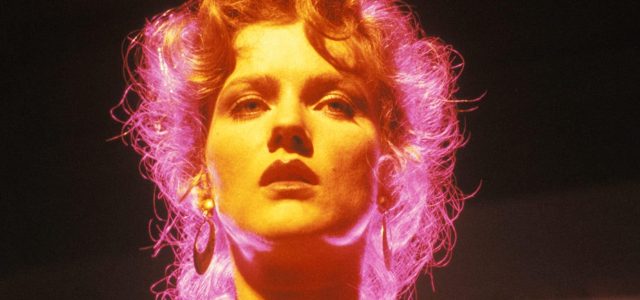
Directed by the prolific Rainer Werner Fassbinder, Lola is the third installment in his acclaimed BRD Trilogy (following The Marriage of Maria Braun and Veronika Voss). It is a vibrant, neon-soaked critique of the “Economic Miracle” in 1950s West Germany, loosely inspired by the classic film The Blue Angel.
The Plot
The story is set in a small Bavarian town that is undergoing a period of rapid capitalist expansion and reconstruction. The local elite—corrupt businessmen and politicians—have carved up the town’s resources for their own profit, operating largely out of a high-end brothel and cabaret.
Enter Von Bohm, an upright, idealistic building commissioner who arrives in town to oversee urban development. Unlike his predecessors, Von Bohm is a man of rigid integrity who refuses to engage in the local culture of bribery and “back-scratching.”
However, his world is turned upside down when he falls deeply in love with a charming, seemingly innocent woman named Marie-Louise. What he doesn’t realize is that Marie-Louise is actually Lola, the star seductress of the local brothel and the mistress of his primary rival, the unscrupulous developer Schuckert. As Lola plays both sides to secure her own social advancement, Von Bohm is forced to confront the messy intersection of his personal morality and the cynical reality of the new German society.
Cast & Crew
| Role | Contributor |
| Director | Rainer Werner Fassbinder |
| Lola | Barbara Sukowa |
| Von Bohm | Armin Mueller-Stahl |
| Schuckert | Mario Adorf |
| Cinematography | Xaver Schwarzenberger |
Key Highlights
-
The Visual Palette: Unlike the drab realism of many post-war films, Fassbinder uses hyper-saturated pinks, blues, and oranges to reflect the artificiality and “sugar-coated” nature of the era’s prosperity.
-
Barbara Sukowa’s Performance: Sukowa’s portrayal of Lola is electric, balancing calculated ambition with a magnetic stage presence that anchors the film’s satirical tone.
-
Social Satire: The film serves as a biting commentary on how easily idealism can be compromised when it meets the seductive power of money and status.
Note: Each film in the BRD Trilogy features a female protagonist whose personal fate serves as a metaphor for the state of West Germany at different stages of its post-WWII history.