
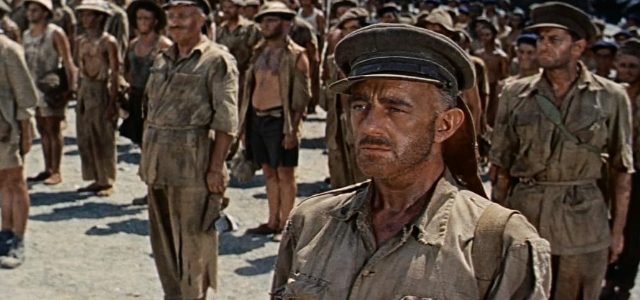
The Bridge on the River Kwai is a sweeping 1957 epic that stands as one of the greatest achievements in cinematic history. Directed by David Lean, it is a complex psychological drama disguised as a war movie, exploring themes of honor, duty, and the “madness” of the military mind.
The Synopsis
Set in 1943 in a Japanese prisoner-of-war camp in the dense jungles of Burma, the story follows a battalion of British soldiers led by the rigid and principled Colonel Nicholson. Upon arrival, Nicholson is thrust into a clash of wills with the camp’s commandant, Colonel Saito, who demands that all prisoners—including officers—work on the construction of a vital railway bridge.
Nicholson refuses on the grounds of the Geneva Convention, enduring brutal punishment to maintain military discipline. However, once he wins his battle of wills with Saito, Nicholson becomes obsessed with the project. He decides that if his men must build a bridge, they will build a masterpiece of British engineering to prove their superiority and maintain morale.
Meanwhile, Shears, an American sailor who successfully escaped the camp, is blackmailed by British Intelligence into returning to the jungle. He joins a commando team led by Major Warden, whose mission is the polar opposite of Nicholson’s: they are trekking through the wilderness to blow the bridge up. The film builds to a high-tension climax where the builders and the destroyers converge, leading to a profound questioning of what “duty” really means in the face of war.
Cast and Crew
| Role | Name |
| Director | David Lean |
| Colonel Nicholson | Alec Guinness |
| Shears | William Holden |
| Major Warden | Jack Hawkins |
| Colonel Saito | Sessue Hayakawa |
| Major Clipton | James Donald |
Legacy & Trivia
-
Oscar Sweep: The film won seven Academy Awards, including Best Picture, Best Director, and Best Actor for Alec Guinness.
-
The Blacklist: The screenplay was written by Carl Foreman and Michael Wilson, but because they were on the Hollywood blacklist at the time, credit (and the Oscar) originally went to Pierre Boulle, the author of the source novel, who didn’t even speak English.
-
The Theme Song: The “Colonel Bogey March,” whistled by the soldiers as they enter the camp, became an international sensation and remains one of the most recognizable melodies in film history.
-
Authenticity: To capture the epic scale, David Lean insisted on building a real, functional bridge in Ceylon (now Sri Lanka) using traditional methods, only to destroy it for the film’s finale.
“Madness… madness!” — Major Clipton