
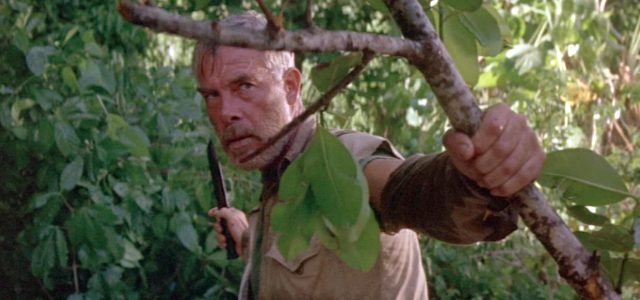
Directed by John Boorman, Hell in the Pacific is a daring and minimalist war drama that strips the genre down to its most primal elements. Eschewing grand battle sequences and complex political backstories, the film focuses entirely on the human condition under extreme duress.
The Synopsis
The story is set during World War II on a tiny, uninhabited island in the Pacific Ocean. Two men—an American Navy pilot and a Captain in the Imperial Japanese Navy—find themselves stranded after their respective crafts are downed. They are the only two people on the island, and they do not speak a word of each other’s language.
Initially, the two men carry the weight of the global conflict onto the sand, engaging in a tense, cat-and-mouse game of territoriality and sabotage. Each views the other as a subhuman enemy to be outsmarted or killed. However, as the harsh tropical environment, lack of fresh water, and isolation take their toll, their mutual hostility begins to give way to an uneasy realization: neither can escape the island alone. The film follows their agonizingly slow transition from mortal enemies to reluctant collaborators as they attempt to build a craft to reach civilization, exploring whether the shared instinct for survival can truly bridge the gap created by war and cultural divide.
Cast & Crew
| Role | Name |
| Director | John Boorman |
| The American Pilot | Lee Marvin |
| The Japanese Captain | Toshiro Mifune |
Production Notes
-
A Two-Man Show: The film is unique for featuring only two actors for its entire duration. Both Lee Marvin and Toshiro Mifune were actual veterans of World War II (Marvin in the U.S. Marines and Mifune in the Imperial Japanese Army Air Service), which lent a profound sense of realism and gravitas to their performances.
-
Language Barrier: In a bold creative choice, the film features no subtitles for the Japanese dialogue. This forces the audience to share the American pilot’s confusion and rely on Mifune’s expressive physical acting to understand his character’s frustrations and motives.
-
The Alternate Ending: There are two known endings to the film. One is a sudden, nihilistic conclusion favored by the studio, while the other (often found on home media) is a more contemplative, open-ended resolution that aligns more closely with Boorman’s original vision.
-
Location Filming: The movie was shot on location in the Palau Islands, providing a lush but oppressive backdrop that emphasizes the characters’ smallness against the vastness of nature.