
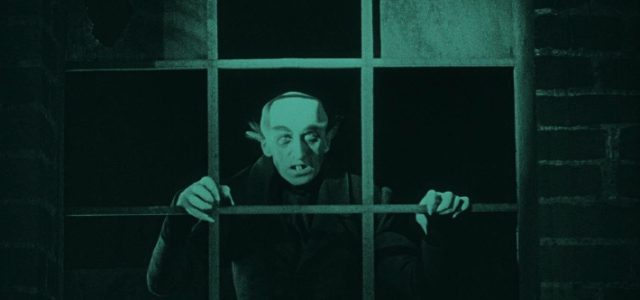
Nosferatu: A Symphony of Horror (Nosferatu, eine Symphonie des Grauens) is the foundational masterpiece of supernatural cinema. Directed by F.W. Murnau, this 1922 German Expressionist film is an unauthorized adaptation of Bram Stoker’s Dracula.
The Plot
Thomas Hutter is a young estate agent in the German city of Wisborg. His employer, the eccentric Knock, sends him on a long journey to the Carpathian Mountains to visit a new client, Count Orlok, who wishes to purchase a house across from Hutter’s own home.
Upon arriving at the Count’s desolate castle, Hutter is unsettled by Orlok’s grotesque, rat-like appearance and strange nocturnal habits. After accidentally cutting his finger, Hutter witnesses the Count’s disturbing obsession with blood. Soon, Hutter discovers that the Count is a “Vampyre,” a creature of the night who carries death in his wake. As Orlok seals himself in a coffin to travel by sea to Wisborg, he brings a literal plague of rats and shadows. Hutter’s wife, Ellen, begins to feel the Count’s psychic presence from across the ocean, realizing that she may be the only one capable of stopping the ancient evil before it consumes their entire city.
Cast & Crew
-
Director: F.W. Murnau
-
Lead Actors:
-
Max Schreck as Count Orlok
-
Gustav von Wangenheim as Thomas Hutter
-
Greta Schröder as Ellen Hutter
-
-
Supporting Cast:
-
Alexander Granach as Knock
-
Ruth Landshoff as Ruth
-
Wolfgang Heinz as First Sailor
-
A Visual Landmark
The film is iconic for Max Schreck’s transformative performance; his stiff, spindly movements and haunting silhouette created a visual language for vampires that persists over a century later. Unlike the “stagey” look of many silent films, Murnau used real locations and innovative camera techniques—such as negative film strips and stop-motion—to create a sense of otherworldly dread.
The film remains a “Symphony of Horror” precisely because it relies on atmosphere and the creeping shadows of German Expressionism rather than dialogue or jump scares.