
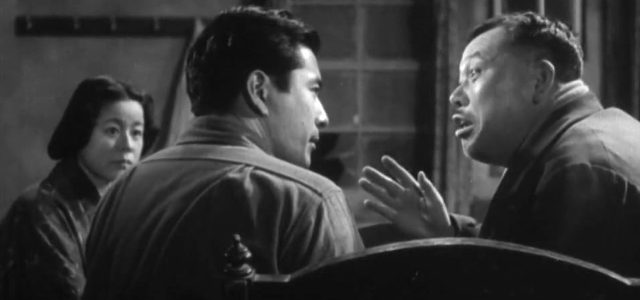
Original title: Shûbun
Directed by Akira Kurosawa, Scandal is a compelling social drama and courtroom thriller released just months before his international breakthrough with Rashomon. It serves as a scathing “protest film” against the rise of yellow journalism and the intrusive tabloid culture that emerged in Japan following World War II.
The Synopsis
The story begins when Ichiro Aoye, a young and successful painter, encounters a famous singer, Miyako Saijo, while on a sketching trip in the mountains. After Miyako misses her bus, Ichiro kindly offers her a ride on his motorcycle to their shared inn. Although their meeting is entirely innocent and brief, they are spotted by a photographer from a sleazy tabloid magazine.
The magazine, seeking to boost sales, publishes a fabricated story titled “The Secret Love of a Singer and a Painter,” complete with a sensationalised photo. Outraged by the lie, Ichiro decides to sue the publication for libel. To represent him, he hires Hiruta, a down-on-his-luck lawyer who appears desperate and somewhat dishevelled. The film shifts its focus to the internal struggle of Hiruta, who is torn between his professional duty and his personal desperation; he is heavily in debt and trying to care for his young daughter, who is bedridden with tuberculosis. As the tabloid editors attempt to bribe the lawyer to throw the case, the film becomes a tense examination of moral integrity, guilt, and the pursuit of truth in a media-saturated world.
Cast & Crew
| Role | Name |
| Director | Akira Kurosawa |
| Ichiro Aoye | Toshiro Mifune |
| Attorney Hiruta | Takashi Shimura |
| Miyako Saijo | Yoshiko Yamaguchi |
| Masako Hiruta | Yoko Katsuragi |
| Hori (Tabloid Editor) | Sakae Ozawa |
Production Notes
-
The Kurosawa Mainstays: The film features the powerhouse pairing of Toshiro Mifune and Takashi Shimura. While Mifune brings his trademark youthful energy to the role of the painter, Shimura provides the film’s emotional core as the conflicted, morally wavering lawyer—a performance often cited as one of his most nuanced.
-
Social Commentary: Kurosawa was personally deeply frustrated by the lack of privacy afforded to public figures in post-war Japan. He used this film to critique what he called “the rise of the press and its habitual confusion of freedom with license.”
-
Visual Motifs: Look for Kurosawa’s use of “the Christmas scene,” a surprisingly sentimental and visually striking sequence that highlights the contrast between the grime of the city and the purity of Hiruta’s daughter’s spirit.
-
A “Frank Capra” Touch: Critics often compare the film’s idealistic ending and its focus on individual redemption to the works of American director Frank Capra, blending a gritty social realism with a hopeful, humanistic outlook.