
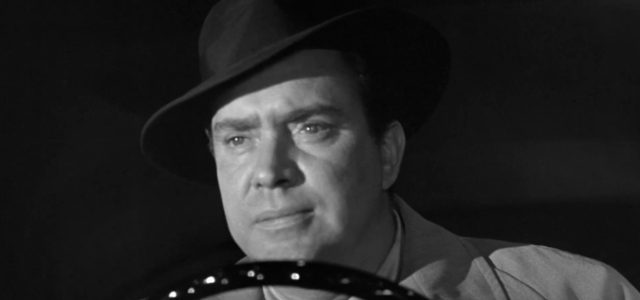
Co-directed by Howard W. Koch and its leading man, Edmond O’Brien, Shield for Murder is a gritty, uncompromising film noir. It stands out in the genre for its unflinching look at police corruption, trading the usual “whodunit” mystery for a tense character study of a man with a badge who has completely lost his moral compass.
The Synopsis
The film opens with a shocking act: Barney Nolan, a veteran police detective with sixteen years on the force, lures a small-time bookie’s runner into a dark alley, murders him, and steals $25,000 in cash. To cover his tracks, Nolan expertly creates a “justifiable homicide” scene, claiming the victim was trying to escape custody.
Nolan’s motive is deceptively simple—he wants to buy a dream home for his unsuspecting fiancée, Patty, and leave his cynical life behind. However, his “perfect crime” begins to unravel almost immediately. A deaf-mute witness saw the murder, and Nolan’s young protégé, Detective Mark Brewster, starts to notice inconsistencies in the veteran’s story. As the police department begins an internal investigation and the local mob realizes their money is missing, Nolan is forced into a desperate, violent downward spiral. He must use his knowledge of police tactics to stay one step ahead of his own colleagues, proving that the most dangerous criminal is the one who knows exactly how the law works.
Cast & Crew
| Role | Name |
| Directors | Edmond O’Brien & Howard W. Koch |
| Barney Nolan | Edmond O’Brien |
| Patty Winters | Marla English |
| Detective Mark Brewster | John Agar |
| Captain Gunnarson | Emile Meyer |
| Packy Reed | Carolyn Jones |
Production Notes
-
A Rare Directorial Turn: This was the directorial debut for Edmond O’Brien, who was already a noir icon for his role in D.O.A. (1949). His intimate knowledge of the genre shines through in the film’s claustrophobic atmosphere and cynical tone.
-
Hard-Boiled Pedigree: The film is based on the novel by William P. McGivern, the same author who wrote The Big Heat. Like that story, Shield for Murder pulls no punches in its portrayal of the thin, often blurred line between the law and the underworld.
-
Location Filming: Much of the movie was shot on location in Los Angeles, using the city’s real-life alleyways and suburbs to ground the heightened drama in a sense of mid-century realism.
-
The Anti-Hero: At a time when most movie policemen were depicted as paragons of virtue, Barney Nolan was a jarringly realistic depiction of a “dirty cop,” predating the more famous rogue officers of the 1970s by nearly two decades.