
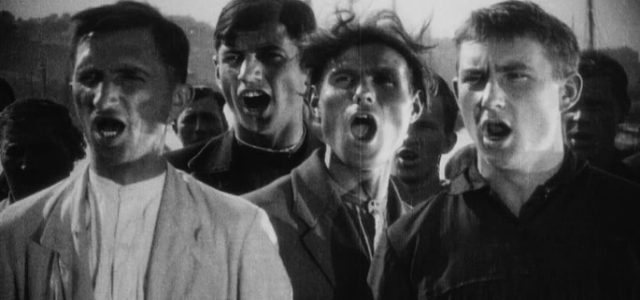
Directed by the visionary Sergei Eisenstein, Battleship Potemkin (1925) is a landmark of world cinema, commissioned to commemorate the twentieth anniversary of the 1905 Russian Revolution. It is widely considered one of the most influential films ever made due to its groundbreaking use of montage.
The Premise
The film is a dramatized account of a real-life mutiny that occurred in 1905. The crew of the massive battleship Potemkin, weary from the hardships of the Russo-Japanese War and pushed to their breaking point by the cruelty of their officers, decides to take a stand. What begins as a localized protest over foul rations quickly escalates into a full-scale rebellion that sparks a revolutionary spirit in the port city of Odessa.
The Key Figures
While the film famously treats the “masses” as the collective hero, several key figures guide the narrative:
-
Aleksandr Antonov stars as Grigory Vakulinchuk, the charismatic sailor who rallies his comrades to defy their oppressors.
-
Vladimir Barsky plays Commander Golikov, the stern and detached officer representing the rigid Tsarist hierarchy.
-
Grigori Aleksandrov (who also assisted Eisenstein in directing) appears as Chief Officer Giliarovsky.
The Structure
The film is masterfully divided into five distinct acts, building tension with rhythmic precision:
-
Men and Maggots: The sailors protest the inedible meat provided by the officers.
-
Drama on the Quarterdeck: The spark of mutiny turns into an all-out battle for control of the ship.
-
An Appeal from the Dead: The citizens of Odessa unite in mourning and solidarity with the sailors.
-
The Odessa Steps: The Tsarist army arrives to violently suppress the civilian uprising in one of the most famous sequences in film history.
-
Meeting the Squadron: The Potemkin must face the full might of the Admiral’s fleet.
Did you know? Eisenstein’s “montage of attractions” theory—the idea that editing should be used to create an emotional shock in the viewer—changed film editing forever. The “Odessa Steps” sequence has been homaged and parodied in countless modern films, from The Godfather to The Untouchables.