
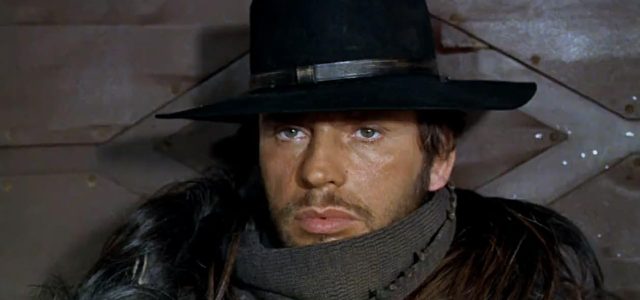
Directed by Sergio Corbucci, The Great Silence (Il Grande Silenzio) is widely considered one of the most unique and influential “Revisionist Westerns” ever made. Eschewing the dusty deserts of Spain for the freezing, snow-covered mountains of the Dolomites, it offers a haunting and subzero take on the genre.
The Premise
The year is 1898. A brutal winter has gripped the Utah territory, forcing outlaws and impoverished locals alike to take refuge in the mountains. Taking advantage of a law that offers bounties for “dead or alive” fugitives, a group of bloodthirsty bounty hunters—led by the sadistic Tigrero—begins a systematic slaughter of these people for profit. In the midst of this icy chaos, a mute gunslinger known only as Silence is hired by a young widow to protect the survivors and eliminate the hunters who murdered her husband.
The Cast
-
Jean-Louis Trintignant stars as Silence, the enigmatic protagonist who uses a Mauser C96 pistol and refuses to speak, having had his throat cut as a child to keep him from testifying.
-
Klaus Kinski delivers one of his most chilling performances as Tigrero (or “Loco” in some dubs), a bounty hunter who follows the letter of the law while wallowing in its cruelty.
-
Frank Wolff plays Sheriff Burnett, a well-meaning but overwhelmed lawman sent to the region to restore order and offer amnesty to the outlaws.
-
Vonetta McGee portrays Pauline, the courageous woman who seeks vengeance and forms an unlikely bond with Silence.
The Conflict
The film is a stark meditation on the failure of the law and the futility of violence. Unlike typical Western heroes, Silence doesn’t seek glory; he seeks to neutralize those who exploit the law for murder. The central conflict pits Silence’s specialized skill set against Tigrero’s cunning and the unforgiving environment. As the snow piles higher, the tension builds toward a confrontation that challenges every convention of the “Hollywood Western” and questions if justice can truly exist in a world ruled by greed.
Why It’s a Masterpiece
-
The Score: The film features a melancholic, ethereal soundtrack by the legendary Ennio Morricone, which perfectly captures the desolate, frozen atmosphere.
-
The Setting: By replacing the “sun-drenched frontier” with a “frozen wasteland,” Corbucci creates a feeling of isolation and hopelessness that was revolutionary for 1968.
-
Visual Style: The use of the Mauser pistol and the vivid red blood against the white snow influenced many modern directors, most notably Quentin Tarantino (specifically in The Hateful Eight).