
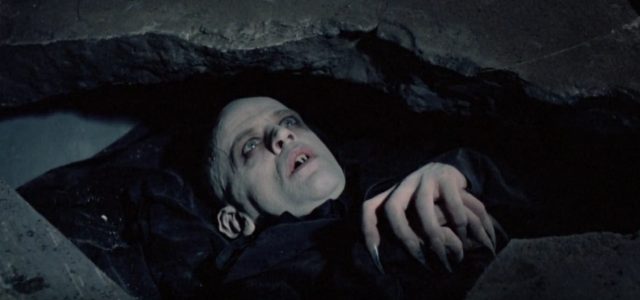
Nosferatu the Vampyre (Nosferatu: Phantom der Nacht) is a hauntingly beautiful reimagining of the vampire mythos. It serves as both a remake of F.W. Murnau’s 1922 silent film and a deeply existential exploration of loneliness and the burden of immortality.
The Plot
Jonathan Harker, a real estate agent from the idyllic town of Wismar, leaves behind his devoted wife, Lucy, to travel deep into the Carpathian Mountains. His mission is to finalize a land deed for the reclusive Count Dracula. Despite the frantic warnings of the local peasants, Jonathan reaches the crumbling castle, where he encounters a pale, skeletal figure who seems to embody death itself.
Unlike the suave predators of other cinema, this Count is a wretched creature who views his eternal life as a stagnant curse. Upon seeing a locket containing Lucy’s portrait, the Count becomes obsessed with her “light” and purity. He immediately sets sail for Wismar, bringing with him a literal and metaphorical darkness. As a phantom ship drifts into the harbour carrying thousands of plague-infested rats, the town is plunged into a nightmare of disease and despair. Lucy, realising the source of the evil, must decide if she is willing to sacrifice her own soul to stop a monster that cannot be killed by mortal means.
Cast & Crew
-
Director: Werner Herzog
-
Lead Actors:
-
Klaus Kinski as Count Dracula
-
Isabelle Adjani as Lucy Harker
-
Bruno Ganz as Jonathan Harker
-
-
Supporting Cast:
-
Roland Topor as Renfield
-
Walter Ladengast as Dr. Van Helsing
-
Dan van Husen as The Warden
-
Vibe & Style
The film is widely regarded for its “painterly” aesthetic, influenced by the works of Caspar David Friedrich. It moves at a deliberate, hypnotic pace, emphasized by the ethereal, choral-heavy score by Popol Vuh.
Klaus Kinski’s portrayal is often cited as one of the greatest in horror history; he manages to make the Count both terrifying and profoundly pitiable. It is a film about the “horror of the soul” rather than simple bloodletting.
“Time is an abyss… deep as a thousand nights. Centuries come and go. To be unable to grow old is terrible.”