
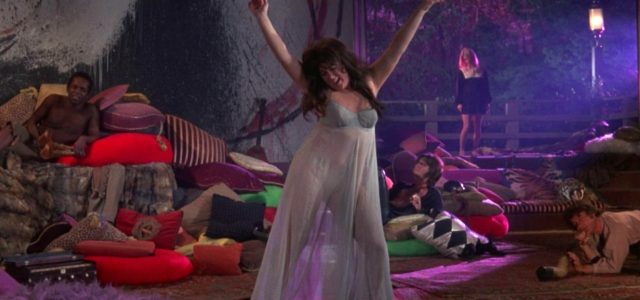
Angel, Angel, Down We Go (1969)
Also released under the sensationalist title Cult of the Damned, this psychedelic melodrama was written and directed by Robert Thom (the mind behind Wild in the Streets). It is a quintessential piece of “Late Sixties” cinema, blending the campy excess of Old Hollywood with the jagged, experimental energy of the counterculture.
The Plot
Tara Nicole Steele is a lonely, self-conscious debutante returning home to Beverly Hills after finishing school. She finds herself trapped in a high-society life defined by her parents’ dysfunctional and transactional marriage: her mother, Astrid, is a fading film star obsessed with her own vanity, and her father, Willy, is a wealthy industrialist with secrets of his own.
At her extravagant “coming out” party, Tara meets Bogart Peter Stuyvesant, a charismatic and manipulative rock singer. Drawn to his rebellious energy, Tara falls under his spell and introduces him to her family. However, Bogart—along with his eclectic entourage—isn’t interested in just joining the family; he intends to systematically dismantle it.
As Bogart seduces and manipulates each family member, the film descends into a surreal exploration of greed, sexual politics, and the generational clash between the “Establishment” and the “New Left.” The story famously utilizes avant-garde “mind-trip” montages and skydiving sequences to illustrate the characters’ emotional disintegration.
Cast & Crew
| Role | Contributor |
| Director / Writer | Robert Thom |
| Astrid Steele | Jennifer Jones |
| Bogart Peter Stuyvesant | Jordan Christopher |
| Tara Nicole Steele | Holly Near |
| Santaro | Roddy McDowall |
| Willy Steele | Charles Aidman |
| Joe | Lou Rawls |
Key Highlights
-
The Return of Jennifer Jones: This marked a rare and controversial appearance for Oscar-winner Jennifer Jones, who shocked audiences by playing a character far removed from her “saintly” roles of the 1940s.
-
Cultural Context: The film was released just days after the Manson Family murders. Fearing its themes of a charismatic leader “corrupting” a family were too close to reality, the studio later retitled it Cult of the Damned to capitalize on the news cycle.
-
Musical Pedigree: Despite its gritty themes, the film features a soundtrack involving professional musicians like Lou Rawls and was a significant early role for singer/activist Holly Near.
Note: Many modern critics view the film as a companion piece to Beyond the Valley of the Dolls—a “soap opera on acid” that captures Hollywood’s frantic attempt to stay relevant during the psychedelic era.