
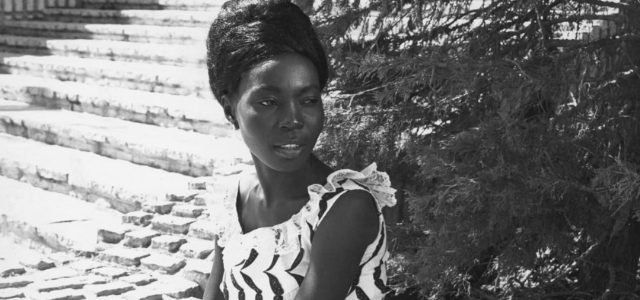
Directed by Ousmane Sembène, often called the “Father of African Cinema,” Black Girl (1966)—originally titled La Noire de…—is a landmark of world cinema. It was the first feature film by a Sub-Saharan African director to receive international acclaim, offering a devastatingly sharp critique of colonialism and its psychological aftermath.
The Premise
The story follows Diouana, a young Senegalese woman living in Dakar, who is recruited by a wealthy French couple to work as a nanny for their children. Excited by the prospect of a glamorous life in France, Diouana moves with them to the coastal town of Antibes on the French Riviera.
However, once they arrive, the dream quickly dissolves. Diouana finds herself confined to the couple’s small apartment, her duties shifting from childcare to grueling, domestic servitude. Stripped of her agency and treated as a decorative object or a faceless laborer by her employers, she begins to realize that while the legal structures of colonialism may have changed, the master-servant dynamic remains firmly in place. The film utilizes a haunting interior monologue to express Diouana’s growing isolation and her quiet, dignified resistance against a world that refuses to see her as a human being.
Key Cast and Crew
-
Director: Ousmane Sembène
-
Diouana: Mbissine Thérèse Diop
-
The Madame: Anne-Marie Jelinek
-
The Monsieur: Robert Fontaine
-
Writer: Based on a short story by Ousmane Sembène
Why It Matters
-
A New Perspective: Black Girl flipped the cinematic lens of the 1960s, giving a voice and a rich internal life to a character who would have been a background extra in a traditional French film.
-
The African Mask: A central motif in the film is a traditional mask Diouana gives to her employers. It serves as a powerful symbol of African identity and the commodification of culture, shifting in meaning as the tension in the apartment rises.
-
Minimalist Power: Clocking in at just under an hour, the film is a masterclass in economy. Sembène uses stark black-and-white cinematography and a non-linear structure to create a feeling of claustrophobia and longing.
“For me, France was the kitchen, the living room, the bathroom, and my bedroom.”
Black Girl is a poetic and tragic exploration of the “post-colonial” condition, examining how the scars of history are carried within the walls of a home.