
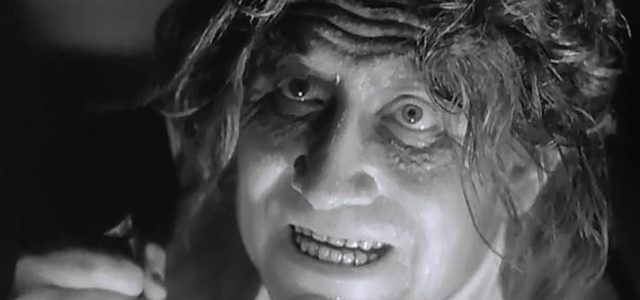
The 1941 adaptation of Dr. Jekyll and Mr. Hyde is a lavish, psychologically-driven retelling of Robert Louis Stevenson’s classic novella. Directed by Victor Fleming (who had recently completed Gone with the Wind and The Wizard of Oz), this version leans away from the “monster movie” tropes of the 1930s to focus on the terrifying duality of the human soul and the dangers of repressed desire.
The Plot
Dr. Harry Jekyll is a brilliant and compassionate scientist in Victorian London who becomes obsessed with the idea that every man is composed of two distinct personalities: one purely good and one purely evil. He believes that if these two can be separated, the “evil” side can be controlled and the “good” side can be liberated.
Despite the warnings of his colleagues and the concern of his fiancée, Beatrix Emery, Jekyll develops a chemical formula to prove his theory. Upon drinking it, he is transformed into Mr. Hyde—a cruel, hedonistic, and violent version of himself who feels no moral restraint. As Jekyll continues his experiments, Hyde begins to frequent the seedier parts of London, where he torments a vulnerable barmaid named Ivy Peterson. Soon, the transformations become involuntary, and Jekyll finds that his “evil” half is no longer a guest in his mind, but a dominant force threatening to consume his life, his love, and his sanity.
Cast & Crew
-
Director: Victor Fleming
-
Lead Actors:
-
Spencer Tracy as Dr. Henry Jekyll / Mr. Hyde
-
Ingrid Bergman as Ivy Peterson
-
Lana Turner as Beatrix Emery
-
-
Supporting Cast:
-
Donald Crisp as Sir Charles Emery
-
Ian Hunter as Dr. John Lanyon
-
Barton MacLane as Sam Higgins
-
C. Aubrey Smith as Bishop Manners
-
Production Note
This film is famous for its “casting swap.” Initially, the studio wanted Ingrid Bergman to play the virtuous fiancée and Lana Turner to play the “bad girl” Ivy. However, Bergman—hoping to prove her range—requested the more challenging role of the victimized Ivy, resulting in one of her most acclaimed early performances. Unlike the 1931 version which used heavy prosthetics, Spencer Tracy’s transformation relied more on intense acting, lighting, and subtle makeup to convey a more “human” and psychological brand of evil.