
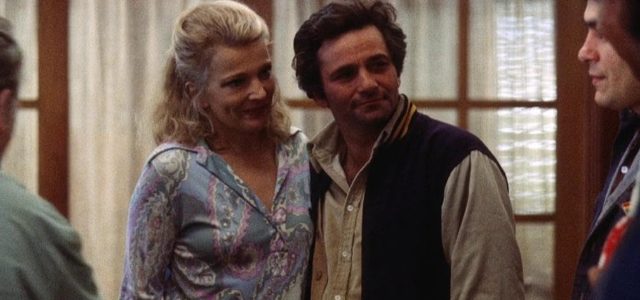
Written and directed by John Cassavetes, this film is a towering achievement of American independent cinema. It is a raw, unflinching, and deeply empathetic portrait of domestic life, mental instability, and the suffocating expectations of “normalcy” in a 1970s working-class household.
The Plot Synopsis
Mabel Longhetti (Gena Rowlands) is a devoted housewife and mother living in a suburb of Los Angeles. She loves her husband, Nick (Peter Falk)—a hard-working, hot-tempered construction foreman—and their three children with an intensity that often spills over into eccentric and socially “inappropriate” behavior.
Mabel doesn’t quite fit the mold of the reserved, composed 1950s-style housewife. She is expressive, hyper-sensitive, and prone to bizarre outbursts and peculiar mannerisms. While Mabel is simply trying to navigate her world through a lens of extreme emotional honesty, those around her—including her own mother-in-law—view her behavior as a sign of dangerous instability.
Nick, though he loves her deeply, is ill-equipped to handle her psyche. He oscillates between fierce protection and violent frustration, often demanding that she “be normal” to appease their friends and family. As the domestic pressure reaches a boiling point during a disastrous series of social gatherings, Nick is forced to make a harrowing decision regarding Mabel’s future. The film follows the fallout of that choice, exploring whether a family can survive when the lines between “personality” and “madness” become tragically blurred.
Key Cast and Crew
| Role | Name |
| Director & Writer | John Cassavetes |
| Mabel Longhetti | Gena Rowlands |
| Nick Longhetti | Peter Falk |
| Martha Mortensen | Katherine Cassavetes |
| George Mortensen | Fred Draper |
| Tony Longhetti | Matthew Cassel |
Style and Impact
-
Gena Rowlands’ Performance: Often cited as one of the greatest performances in film history, Rowlands (Cassavetes’ real-life wife) delivers a tour de force that is both agonizing to watch and impossible to look away from. She earned an Academy Award nomination for the role.
-
Cinéma Vérité Style: The film uses long, handheld takes and improvised-feeling dialogue to make the audience feel like an intruder in the Longhetti household. There is no traditional “film score” to tell you how to feel; the tension comes entirely from the actors.
-
Independence: Because no major studio would touch the script, Cassavetes famously mortgaged his house and used a crew of volunteer film students to get the movie made.
The Core Conflict: The film asks a haunting question: Is Mabel actually “crazy,” or is she simply a unique spirit being crushed by a society—and a husband—that demands total conformity?