
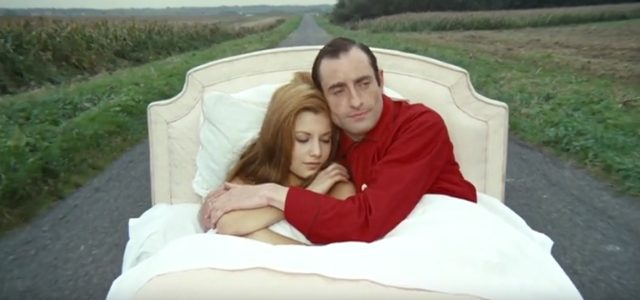
Directed by the legendary French comedian and filmmaker Pierre Étaix, Le Grand Amour is a whimsical, visually inventive masterpiece of slapstick and surrealism. Often compared to the works of Buster Keaton and Jacques Tati, Étaix brings a unique, poetic touch to this satirical exploration of marriage, boredom, and the “grass is greener” syndrome.
The Synopsis
The story follows Pierre, a mild-mannered man who has settled into a comfortable, if somewhat monotonous, life. He marries Florence, a woman from a wealthy family, and takes a position in his father-in-law’s factory, which specialises in manufacturing leather goods. While Pierre is genuinely fond of his wife, his life becomes a predictable loop of domestic routines and social obligations.
The “great love” of the title is put to the test when a new, young, and radiant secretary named Agnes is hired at the office. Pierre becomes instantly infatuated, falling into a world of elaborate daydreams to escape the humdrum reality of his marriage. The film brilliantly portrays his internal struggle through surreal sequences—most famously a dream where Pierre’s bed becomes a motorised vehicle that he drives through the French countryside alongside dozens of other “bed-drivers.” As Pierre navigates the comedy of errors that is his daily life, he is forced to decide whether he will pursue this new fantasy or find a way to rediscover the spark in the life he has already built.
Cast & Crew
| Role | Name |
| Director | Pierre Étaix |
| Pierre | Pierre Étaix |
| Florence | Annie Fratellini |
| Agnes | Nicole Calfan |
| Florence’s Mother | Ketty France |
| Florence’s Father | Louis Maiss |
Production Notes
-
The Étaix/Carrière Partnership: The film was co-written by the renowned Jean-Claude Carrière, a frequent collaborator of Luis Buñuel. This partnership explains the film’s seamless blend of deadpan comedy and surreal, dreamlike logic.
-
A Real-Life Duo: The actress playing Pierre’s wife, Annie Fratellini, was Pierre Étaix’s real-life wife at the time. She came from a famous circus family, and the two later founded the École Nationale du Cirque together.
-
Visual Gags: The film is packed with intricate, perfectly timed visual gags that require no dialogue to understand. Étaix’s background as a circus performer and illustrator is evident in the precise framing and physical comedy throughout.
-
Restoration Success: For decades, Étaix’s films were tied up in legal disputes and were virtually impossible to see. A massive legal and restoration effort in the late 2000s finally brought Le Grand Amour back to audiences, revealing it as a vibrant and essential work of French comedy.