
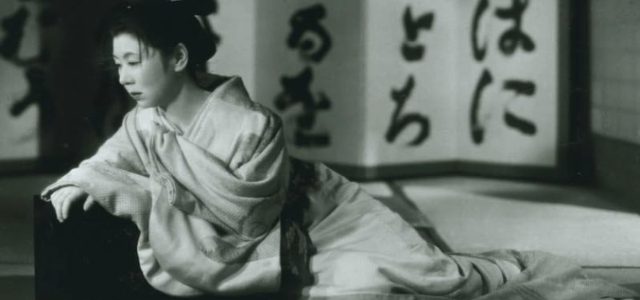
Original title: Saikaku ichidai onna
Directed by the legendary Kenji Mizoguchi, The Life of Oharu is a masterpiece of Japanese cinema and a definitive work of world realism. It is a sweeping, tragic epic that examines the social rigidity of the Edo period through the lens of one woman’s long, heartbreaking decline.
The Synopsis
The story is told in a series of extended flashbacks, beginning with Oharu as an ageing, destitute prostitute seeking shelter in a temple. As she looks upon the statues of the Buddha, she remembers her life as a young woman of high status in the imperial court of Kyoto.
Her downfall begins when she falls in love with a man of a lower social caste. The discovery of their forbidden affair leads to his execution and Oharu’s exile, marking the start of a relentless downward trajectory. Over several decades, Oharu is passed from one social stratum to the next: she becomes a concubine to a powerful lord in hopes of providing an heir, a high-ranking courtesan, a servant, and eventually a common street walker. Despite her dignity, beauty, and resilience, every attempt she makes to regain a sense of stability is thwarted by the unforgiving patriarchal laws and the cold whims of the men who control her fate.
Cast & Crew
| Role | Name |
| Director | Kenji Mizoguchi |
| Oharu | Kinuyo Tanaka |
| Katsunosuke (The Lover) | Toshiro Mifune |
| Lord Matsudaira | Toshiaki Konoe |
| Oharu’s Father | Ichirō Sugai |
| Old Lady | Hisako Yamane |
Production Notes
-
The Mizoguchi Style: The film is famous for Mizoguchi’s use of long, flowing takes and “one scene, one shot” choreography. This style creates a sense of inevitability and distance, forcing the viewer to observe Oharu’s tragedy as an inescapable part of the landscape.
-
Kinuyo Tanaka’s Performance: Widely regarded as one of the greatest performances in film history, Tanaka portrays Oharu from ages 20 to 50. She captures the physical and emotional erosion of the character with incredible nuance and grace.
-
International Recognition: After years of being overlooked in the West, this film won the International Prize at the Venice Film Festival, helping to cement Mizoguchi’s reputation alongside Kurosawa and Ozu as the “Big Three” of Japanese cinema.
-
Source Material: The film is based on the 17th-century novel The Life of an Amorous Woman by Ihara Saikaku. While the novel is somewhat satirical, Mizoguchi and screenwriter Yoshikata Yoda transformed it into a solemn, empathetic critique of gender and class oppression.