
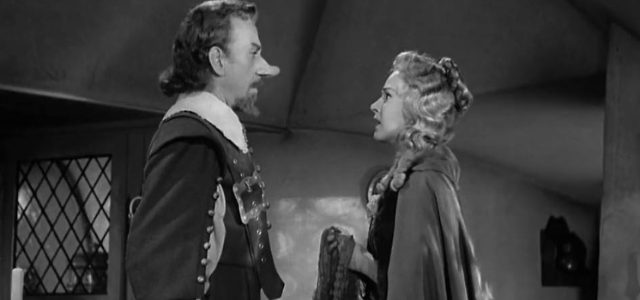
Directed by Michael Gordon, the 1950 film adaptation of Cyrano de Bergerac is the first English-language version of Edmond Rostand’s classic 1897 play. It remains a definitive cinematic achievement, largely due to its powerhouse lead performance.
The Premise
Set in 17th-century Paris, the story follows Cyrano de Bergerac, a brilliant poet, philosopher, and peerless swordsman serving in the French Army. Cyrano is a man of immense talent and courage, yet he is plagued by a debilitating insecurity: his extraordinarily large nose. Convinced that his appearance makes him unlovable, he keeps his deep passion for the beautiful and intellectual Roxanne a secret.
The Cast
-
José Ferrer stars as Cyrano de Bergerac, a role that earned him the Academy Award for Best Actor. His performance is legendary, capturing both the sharp-tongued wit of the brawler and the soul-crushing vulnerability of the poet.
-
Mala Powers plays Roxanne, the object of Cyrano’s affection who values wit and soul above all else.
-
William Prince portrays Christian de Neuvillette, a handsome but dim-witted new recruit who is also in love with Roxanne but lacks the words to woo her.
-
Morris Carnovsky appears as Le Bret, Cyrano’s loyal friend and confidant.
The Conflict
The plot thickens when Roxanne confesses to Cyrano that she is infatuated with Christian. When Christian admits to Cyrano that he is incapable of speaking eloquently to a woman, Cyrano strikes a bittersweet bargain: he will provide the “mind” while Christian provides the “face.”
By ghostwriting Christian’s letters and whispering poetic declarations from the shadows, Cyrano is finally able to express his soul to the woman he loves, even if she believes the words belong to someone else. As the Siege of Arras looms and the characters are swept into war, the tension between physical beauty and inner brilliance reaches a heartbreaking peak.
A Cinematic Milestone
The Nose: The prosthetic nose worn by José Ferrer was a marvel of the time, designed to look integrated and natural enough that the audience forgets the artifice and focuses on the character’s pain.
Awards: This film was a critical darling, and Ferrer’s Oscar win made him the first Hispanic actor to win in the Best Actor category.